In this article for the Huffington Post, writer Kelly Dorfman says "we are not very nice to the overweight."
Isn't that a fact! In writing How We Did It, I talked with many people who had achieved weight loss who had been subject to cruel remarks and thoughtless actions from other people. Kelly Dorfman calls us on our attitudes.
"The conversation I would like to have about obesity is about acceptance and
being kind to each other," she says. "Gaining weight is a part of our modern life. All sorts
of things happen that turn thin people into chubby people. That fat person you
view with disdain today could be you tomorrow."
Hear! Hear! I'm all for acceptance and kindness. We all need to battle our nasty inner voices that spew condemnation all over the place -- directed to others as well as to ourselves.
I know from talking with hundreds of people about weight loss that for
many, dropping excess weight is as much about what's going on in their
head as what's going in their mouth. Overeating can be a vicious cycle
in which you feel so bad about yourself -- often because of comments or actions by others -- that you run to what comforts
you the most: food. Then, of course, you feel bad again after the
feelings of relief wear off.
But I fear that Ms. Dorfman's statement that "gaining weight is a part of our modern life" lets us all off too easily. Yes, there are medical conditions and medicines that make weight loss difficult and even impossible. I get that. Aging and a slowing metabolism are a contributing factor -- that I know for sure! But most of us do not put on extra weight for these reasons. For the vast majority of us, excess weight is a combination of too much food and too little movement.
I know that no one wants to hear that same old, same old, blah, blah, blah. But in my mind, there's no simpler way to put it. We know this in our hearts, yet we can't put it to work for us unless we embrace the facts and act on them.
And here's where I question Ms. Dorfman. Cruel as people may be, I found that many people in How We Did It were shocked into action by thoughtless comments. Certainly no one wants to be the target of cruelty, but would these people have begun their weight loss journey without the jolt of reality that these comments provided? Most often, the comments weren't personal attacks, but statements of reality: "She weighs more than I do," one doctor said outside an exam room. "Mr. M. is fat," some students said about a substitute teacher.
I wish there were another way, but I'm not sure what the alternative is. Well, I do know of one. Several people I talked with were moved to action when a spouse or friend lovingly told them that they were becoming concerned for their health. Putting the focus on health and not weight and body image may be the way to go. A few others saw or heard the words "morbid obesity" applied to them and became fearful enough of disability or early death to take action.
Still, I'm not certain these softer messages -- or even the cruelest comments -- are strong enough to move most people to action. Even when thoughtless comments stung, people often needed something more in order to help themselves. Many credit seeing unflattering photos or a glimpse in a mirror with providing the final piece of the puzzle. For some, it was the inability to do the simplest daily task or having to ask for the seat belt extender on a plane.
Whatever the motivator, what's certain is that a person needs to own their present situation and resolve to do what it takes to improve it. What do you think? Have you been the target of unkind remarks? If you could change something about the way people react to you, what would it be? If you've lost weight, what finally moved you to action?
Wednesday, October 24, 2012


Wednesday, July 11, 2012
Diane's incredible weight loss story
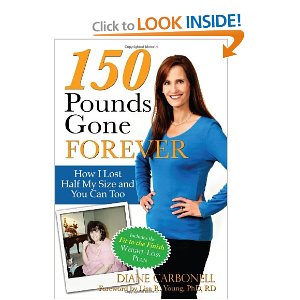 One of the weight loss blogs I've followed over the years is Diane Carbonell's Fit to the Finish. Diane once weighed over 300 pounds, but she went
on to lose half her size on a three-pronged program of her own making. No one
had to bully her into it, or jolly her into it -- Diane just set her mind to it
and within a year had reached her goal.
Diane has blogged about her weight loss on Dr. Oz's blog and television show, and been interviewed on the 700 Club. Now Diane has come out with her own book about her weight loss, 150 Pounds Gone Forever: How I Lost Half My Size and You Can Too.
I appreciate Diane's approach to weight loss. She's not a cheerleader or a
bully. Instead, she is a knowledgeable and inspiring guide. Her approach is one
of quiet confidence: "I did it, and so can you." Hers is the perfect
approach to weight loss, as it builds an inner desire to succeed, rather than
relying on external motivators that will eventually fail.
In her book, Diane tells stories of her years as an obese young wife and mother, the agonies of day-to-day interactions with others as well as the self-condemning inner dialog that kept her running to food for comfort, trapping herself in her burgeoning body. It takes a brave person to reveal so many embarrassing moments (not to mention before photos!).
Along with her personal story, Diane includes useful information about nutrition, exercise and weight loss strategies, like how to grocery shop, read labels, and estimate caloric needs. She includes sections on the importance of planning and forethought when on a mission to lose weight. She even includes her favorite family recipes.
But I think one of the features of the book that I most appreciated is one that characterizes Diane's blog -- Diane asks great questions that will get you thinking about your own weight issues. "What did you have for dinner last night?" "Does fear of failure stop you from trying to get healthy?" "Do you ever eat in the car?" These seem like simple questions, but they can get at the core of your personal dilemmas. (I don't eat in my car, so the question made me think, "Where do I mindlessly eat?")
I would recommend this book to anyone wanting a sensible, surefire way to attack a weight problem. Long after "The Biggest Loser" lands in the junk heap of discarded television shows, this kind of book will live on as an inspiring guide from someone who knows that you can indeed do it, because she did.
Thursday, April 26, 2012
Livin La Vida Low Carb Podcast
 One of the weight loss successes I profile in How We Did It is Jimmy Moore, a man who lost 180 pounds on the Atkins diet. Jimmy was so inspired by his achievement that he has become a full-time advocate and enthusiastic blogger for weight loss success.
What I really appreciate about Jimmy's approach to weight loss is that while he succeeded on Atkins, he realizes that it's not the only plan with which you can find success. He fully supports people who choose another plan. He's all about success! He provided me with the quote that ends my book: "Dance with the one that brung ya!" In other words, if it words for you--whatever it is--stick with it.
Jimmy has endless amounts of information on his website Livin La Vida Low Carb. As part of his blog, he posts podcasts with people involved in weight loss--including me! Click on this link to listen to our interview, which Jimmy ran earlier this week. It's the longest interview I've done for my book--36 minutes!--so I really had the chance to go into depth about the book and the inspiring people in it. I hope you enjoy listening in!
Monday, April 16, 2012
Bye bye to back pain!
 At one time, I suffered lower back pain that was bad enough to land me in physical therapy... not once but twice. I finally got the message and did two things: started swimming laps and in doing so, lost weight.
Losing 30 pounds and continuing my regular lap swimming (2-3x/week) has kept the ache away. I'd recommend swimming to anyone who suffers from lower back pain. It doesn't take much to whack that pain. I swim for just a half an hour and, if I have the time, I sit in the hot tub for a minute or two afterward.
In the new Chicken Soup book, Say Goodbye to Back Pain, I write about my hassle with back pain and my solution. It's a funny story about how I got to the point of not being able to pick up my child because of the pain, and what I had to do one day when I had to get him, kicking and squalling, to the car when he didn't want to leave the park. There are some great stories, and great solutions, in this book. Maybe one will help you, too.
Friday, March 30, 2012
Mindless eating... it's how we eat!
 One of the books I relied on for good -- and fascinating -- information for How We Did It was Dr. Brian Wansink's Mindless Eating: Why We Eat More than We Think.
Dr. Wansink is called a "food psychologist." From his lab at Cornell University, he conducts experiments into the factors that lead us to eat what we eat. And you'd think that we eat what we eat because it tastes good, right? Wrong!
In some of his crazy experiments, Dr. Wansink has uncovered the many misguided reasons we eat. Among them are these:
- The size and shape of a bowl can almost double the amount of food you eat.
- Restaurants can get you to eat more by describing their menu items with adjectives.
- You will eat more candy if you throw away the wrappers as you go along than if you let the wrappers pile up.
- If you have bread served with dipping oil rather than with butter, you'll consume less bread but more calories.
- Grocery store signs that read 3-for-$3 rather than $1/each can more than double our purchases.
These are just a few of the fascinating facts Dr. Wansink has confirmed with his research. How can you apply this information to your food consumption? "By encouraging healthy, mindful eating, we can decrease obesity," Wansink says. "A keen awareness of all these hidden persuaders is an important step in controlling the amount and quality of food you eat."
For me, "mindful eating" means this:
I will not eat straight from a package. If I want some crackers, I'll put some on a plate.
I will not eat something just because it's there. Most chocolate made in the U.S. tastes like wax. I've stopped eating my son's leftover Halloween candy. If I want chocolate, I'll eat just a little bit of really good chocolate.
I absolutely do not shop when I'm hungry. The temptations are just too overwhelming. I'll have a small, healthy snack before I go, even if I'm in a hurry.
If I eat while watching TV, I choose the snack beforehand and set it out on the coffee table. No trips to the kitchen during a show!
How about you? What does "mindful eating" mean for you?
Thursday, March 8, 2012
Fast food = slow progress
It's a beautiful day here in the Northeast, more like May than March. I'm going to strap on my sneakers and go walk around town in a minute.
Walking is a great activity for weight maintenance. But its benefit also can be deceiving. It's all too easy to fall into the trap of thinking, "Oh, I just walked for a half hour. Now I can go get that hamburger I've been craving."
Most people overestimate the benefit of exercise and underestimate the damage that fat and sugar-laden food can do. For example, say you eat a Big Mac meal with medium fries. (Let’s assume a diet drink, just to be virtuous.)
According to McDonald’s nutritional information, a Big Mac has 540 calories, while the medium order of fries has 380 calories, so your meal totals 1,480 calories.
How long to you think you’d have to exercise to burn off those calories? An hour? Two hours? Guess again.
According to the most recent government data, a 154-pound person would need to walk briskly for more than three hours to account for this meal! A more sedate pace would require more than five hours of hoofing.
And consider this: Most people who have a plan for losing weight do it by trying to limit their daily calorie intake. That same 154-pound person might have set a limit of 1,500 calories a day. Wow! They'll have a whole 20 calories to play with that day!
And when we're talking fast food, we can't neglect to talk about fat content. Again, consider the medium Big Mac meal. Of the Big Mac's 540 calories, 260 of them come from fat. It contains 29 grams of fat -- fully 45 percent of the recommended daily value. And the fries? Of the 380 calories, 170 come from fat. Their 19 grams of fat are 29 percent of the recommended daily value. So together, the two items account for 74 percent of your daily allotment.
Is that meal really worth it?
Most people who talked with me about their weight loss for How We Did It pinned their weight dilemma on overindulgence in fast food. McDonalds, Wendy's, Taco Bell, Five Guys, Cinnabon, Pizza Hut--the list of fast food outlets is almost literally endless.
So, the next time you want to reward yourself after a workout, banish the thought of junk food. I'm usually starving after I swim my laps and need something with a little protein, so I put together some cheese and crackers and apple slices. What do you do?
Saturday, March 3, 2012
We've hit the airwaves!
 I was interviewed recently about How We Did It by Andy Farmer of KNEO radio. KNEO is a Missouri radio station that also reaches parts of Oklahoma, Kansas and Arkansas.
Andy asked some great questions about the book: How DID people do it? Is weight loss a one-size-fits-all proposition? What are some of your favorite success stories in the book? (To which I replied: All of them!) What can we do about the childhood obesity rate in this country?
To listen to the interview, click on this link to go to KNEO's website. Enjoy!
Subscribe to:
Posts (Atom)